How to Beat DUI Charges in Georgia?

How to Beat
DUI Charges in Georgia
Georgia takes driving under the influence seriously. A conviction under O.C.G.A. § 40-6-391 can mean jail time, a suspended license, thousands of dollars in fines, mandatory DUI school, and a permanent criminal record. But being arrested for DUI is not the same as being convicted. The prosecution must prove its case beyond a reasonable doubt—and there are often significant gaps between what law enforcement documented and what actually happened.
This article covers the most powerful defenses available in Georgia DUI cases, explains the legal and scientific weaknesses commonly found in these prosecutions, and tells you exactly what you need to do in the critical hours and days after an arrest.
Understanding What the State Must Prove
Before exploring defenses, it helps to understand the prosecution's burden. Under Georgia law, the State must prove that you were driving or in actual physical control of a vehicle, on a highway or other public or private property open to the public, while under the influence of alcohol or drugs to the extent that it was less safe for you to drive—or while having a blood alcohol concentration (BAC) of 0.08 grams or more at any time within three hours of driving.
Each of these elements is a potential point of attack. A skilled attorney doesn't just challenge the breathalyzer number—they examine every link in the chain that led to your arrest and subsequent testing.
The 10 Most Effective DUI Defenses in Georgia
The Fourth Amendment requires law enforcement to have reasonable articulable suspicion before stopping your vehicle. If the officer lacked a legitimate basis for the stop—a broken taillight, a minor traffic infraction, or even a hunch—everything that followed may be suppressible under the exclusionary rule. No stop, no case.
The Standardized Field Sobriety Tests (SFSTs)—the Horizontal Gaze Nystagmus (HGN), Walk-and-Turn, and One-Leg Stand—are only scientifically validated when administered in strict compliance with NHTSA protocols. Improper instructions, uneven surfaces, inadequate lighting, or failure to account for medical conditions can all invalidate the results entirely.
Georgia courts apply the Daubert standard to expert and scientific testimony. HGN evidence requires proper foundation—officers must qualify as experts, and the test must have been correctly administered. Challenging the officer's qualifications or the administration procedure can get HGN results excluded, removing some of the State's most persuasive evidence.
Georgia uses the Intoxilyzer 9000 for breath testing. These machines require regular calibration and maintenance, proper operation by a certified operator, and a valid observation period (typically 20 minutes pre-test to ensure no mouth alcohol contamination). Gaps in maintenance logs, operator certification failures, or protocol deviations can fatally undermine the breath test result.
Alcohol absorption takes time. If you had a drink shortly before driving, your BAC may have still been rising at the time of the stop and only reached the 0.08 threshold by the time testing occurred. A toxicology expert can retroactively calculate your BAC at the time of driving and demonstrate it was below the legal limit—even if the test showed otherwise.
Georgia DUI checkpoints are constitutional only if they follow strict procedural requirements—a supervisory decision to set the checkpoint, neutral selection criteria, adequate advance publicity, and minimal intrusion. Many checkpoints fail to meet all requirements. If the checkpoint was unconstitutional, the stop and everything derived from it must be suppressed.
Once you are in custody and subject to interrogation, officers must advise you of your Miranda rights. Statements made in violation of Miranda—including admissions about drinking—can be suppressed. This doesn't automatically end the case, but it can remove damaging admissions the State intended to use against you.
Numerous medical conditions—diabetic hypoglycemia, GERD (gastroesophageal reflux disease), inner ear disorders, neurological conditions, and even fatigue—can produce symptoms that officers mistakenly attribute to alcohol impairment. GERD, in particular, can cause mouth alcohol that artificially inflates Intoxilyzer readings. Medical records and expert testimony can rebut the officer's observations.
Georgia DUI law applies to anyone in "actual physical control" of a vehicle—but courts apply a fact-specific test. If you were parked, sleeping in the back seat, with no keys in the ignition, in a location inconsistent with having driven, the prosecution may struggle to prove this essential element. The surrounding circumstances matter enormously.
For blood test cases, the State must prove an unbroken chain of custody from the draw to the laboratory analysis. Errors in collection (wrong tube type, improper preservatives), storage, labeling, or handling can compromise the integrity of the sample and provide grounds to challenge—or exclude—the blood test results.
"Every DUI arrest tells a story. My job as your attorney is to read the entire file—every maintenance log, every certification record, every frame of dashcam footage—and find where the story falls apart."
— Arash Jafary, Esq., Assured Justice Law Firm
The 30-Day ALS Deadline: Don't Miss It
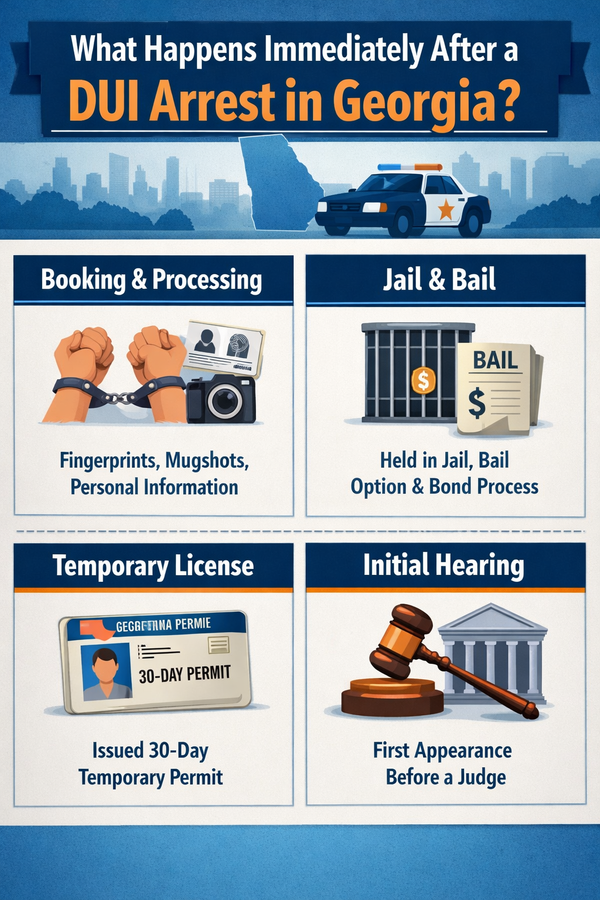
One of the most urgent—and most commonly missed—steps after a DUI arrest in Georgia is requesting an Administrative License Suspension (ALS) hearing. If you were arrested for DUI and either submitted to a breath or blood test that showed a BAC of 0.08 or higher, or refused testing, the Georgia Department of Driver Services will automatically suspend your license.
You have 30 days from the date of arrest to request an ALS hearing and pay the $150 filing fee. Miss that deadline and your license is suspended automatically, without any hearing, for a period ranging from one year (first refusal) to three years (second refusal within five years).
The ALS hearing is entirely separate from your criminal DUI case. Even if your criminal charges are eventually reduced or dismissed, a missed ALS deadline means your license is still suspended. An attorney can file the request immediately upon retention and simultaneously subpoena the arresting officer to appear—creating leverage and an early opportunity to cross-examine the officer under oath.
What Happens If the DUI Cannot Be Beaten Outright?
Not every DUI case results in outright dismissal—but that doesn't mean your only option is a conviction. An experienced attorney can often negotiate the following outcomes:
- Reduction to Reckless Driving — Sometimes called a "wet reckless," this carries significantly lower penalties, no mandatory license suspension for a first offense, and does not count as a prior DUI for sentencing enhancement purposes.
- Negotiated Plea to a Lesser Offense — In cases with stronger State evidence, negotiating to a non-DUI offense can still protect your driving record, employment, and professional licenses in ways a DUI conviction cannot.
Why Your Attorney's Background Matters
In DUI defense, there is no substitute for inside knowledge. An attorney who has stood at the prosecutor's table who has presented these very cases to juries, who has worked with the same Intoxilyzer operators and the same field sobriety test instructors understands precisely where the weaknesses lie and how the State will try to hide them.
At Assured Justice Law Firm, our founder spent years as an Assistant Solicitor General prosecuting DUI cases in metro Atlanta. That prosecutorial experience isn't a footnote on a résumé. It's a strategic advantage that shapes every motion we file, every cross-examination we conduct, and every negotiation we enter.
What to Do Immediately After a DUI Arrest
- Write down everything you remember about the stop, including the officer's instructions, the conditions of the roadside tests, and any statements made.
- Preserve all receipts, credit card records, or witnesses who can corroborate your whereabouts and consumption before driving.
- Do not post anything about the arrest on social media.
- Do not contact the arresting officer or attempt to explain yourself to law enforcement.
- Contact a DUI defense attorney immediately—ideally within 24 to 48 hours, and no later than 10 days after arrest to ensure the ALS hearing deadline is met.
Frequently Asked Questions
Can I beat a DUI if I failed the breath test?
Yes. Breath test results can be challenged on numerous grounds: improper calibration, operator error, failure to observe the required waiting period, or medical conditions that affect results. Failing the breath test makes the case harder, but far from unwinnable.
What if I refused the breathalyzer?
Refusal triggers automatic ALS suspension and can be used against you in court as evidence of consciousness of guilt. However, it also deprives the State of chemical test evidence, potentially weakening their case. Refusal situations require careful strategic analysis.
How long does a Georgia DUI stay on my record?
A DUI conviction in Georgia is permanent and cannot be expunged under current law. This makes fighting the charge or negotiating a reduction critically important. It also underscores why acting quickly with the right attorney is essential.
Is a first DUI a felony in Georgia?
A first DUI is generally a misdemeanor in Georgia. However, certain aggravating factors a child passenger under 14, causing serious injury or death, or having three or more prior DUI convictions within ten years can elevate the charge to a felony.
Do I need an attorney for a first-time DUI?
Absolutely! The consequences of a DUI conviction even a first offense are severe and long-lasting. An experienced attorney can identify defenses you would never see on your own, file motions to suppress illegal evidence, negotiate with prosecutors, and protect your driving privileges through the ALS process.
Facing a DUI charge in Georgia is frightening, but it is not hopeless. With the right attorney examining every piece of evidence, every police procedure, and every scientific claim the State intends to make, the outcome of your case can be dramatically different from what it first appears.
This article is for informational purposes only and does not constitute legal advice. Every DUI case is fact-specific. Contact a licensed Georgia attorney to discuss your particular circumstances.
Facing DUI Charges in Georgia?
Get a confidential case evaluation from a former prosecutor who knows exactly how the State builds its case—and how to tear it apart.
Call for a Free Consultation