What is the Penalty for DUI in Georgia?

What Is the Penalty for DUI in Georgia?
Georgia takes drunk driving extremely seriously. Under O.C.G.A. § 40-6-391, it is unlawful to operate a motor vehicle while under the influence of alcohol, drugs, or any combination thereof. The law sets a per se limit of 0.08% blood alcohol concentration (BAC) for drivers 21 and older, 0.04% for commercial drivers, and 0.02% for drivers under 21.
Penalties escalate dramatically with each subsequent offense — and even a first-time DUI can upend your life. Here's a comprehensive breakdown.
Georgia DUI Penalties at a Glance
Offense
- 12 months probation
- 24 hours – 12 months jail
- $300 – $1,000 fine
- 40 hours community service
- DUI school (Risk Reduction)
- License suspended up to 1 year
- Clinical evaluation
Offense
- 12 months probation
- 72 hours – 12 months jail
- $600 – $1,000 fine
- 30 days community service
- DUI school required
- License suspended 3 years
- Ignition interlock device
- Photo published in newspaper
Offense
- 120 days – 12 months jail
- $1,000 – $5,000 fine
- 30 days community service
- Habitual Violator status
- License revoked 5 years
- Ignition interlock device
- Vehicle may be seized
- Possible felony if 4th offense in 10 years
First DUI Offense in Georgia
A first-time DUI in Georgia is a misdemeanor, but do not let that word fool you — the consequences are severe and long-lasting. Under O.C.G.A. § 40-6-391(c)(1), a first offender faces:
Jail Time: A minimum of 24 hours in jail, up to 12 months. Judges often impose additional time to serve, depending on the circumstances of the arrest, your BAC level, and whether an accident occurred.
Fines: Between $300 and $1,000, plus surcharges and court costs that can push the total financial burden well above $2,000 to $4,000 when all fees are factored in.
Probation: Up to 12 months of probation, during which you must comply with all conditions, report to a probation officer, and avoid any new arrests.
Community Service: A minimum of 40 hours of community service must be completed.
DUI School: Georgia's Risk Reduction Program (commonly called DUI school) is mandatory. This is a 20-hour course administered by licensed providers.
License Suspension: Your license can be suspended for up to one year. However, you have only 30 days from your arrest to request an Administrative License Suspension (ALS) hearing or apply for an ignition interlock limited permit — failure to act in time results in automatic suspension.
Substance Abuse Evaluation: A clinical evaluation is required, and you may be ordered to complete a treatment program.
Second DUI Offense in Georgia
A second DUI within ten years is still a misdemeanor in most cases, but the penalties jump sharply. Georgia lawmakers want to deter repeat offenses, and the mandatory minimums reflect that intent.
Jail Time: A mandatory minimum of 72 hours in jail, with the possibility of up to 12 months behind bars. Courts take second offenses seriously, and additional jail time beyond the minimum is common.
Fines: Between $600 and $1,000, again with surcharges and fees pushing total costs significantly higher.
Community Service: At least 30 days of community service.
License Suspension: Your license will be suspended for three years. After 18 months, you may be eligible for reinstatement, but an ignition interlock device will be required.
Ignition Interlock Device (IID): Georgia requires an IID — a breathalyzer installed in your vehicle that prevents it from starting if alcohol is detected — for a period determined by the court.
Public Notification: Georgia law requires that your name, photo, and DUI conviction be published in the local newspaper at your own expense. This unique provision is designed to carry a social consequence alongside legal ones.
Third DUI Offense — and the Felony Threshold
A third DUI within ten years is classified as a high and aggravated misdemeanor in Georgia, which carries more severe sentencing exposure than a standard misdemeanor. The mandatory minimum rises to 120 days in jail, up to 12 months.
Perhaps more significantly, a third conviction triggers Habitual Violator status under O.C.G.A. § 40-5-58. This means your driver's license is revoked for five years. During that period, driving without a valid license as a Habitual Violator is itself a felony offense.
A fourth DUI within ten years crosses into felony territory under O.C.G.A. § 40-6-391(c)(4). A felony DUI conviction can result in one to five years in prison, a fine of up to $5,000, and the full array of consequences that come with a felony record — including the loss of voting rights, firearm rights, and significant employment barriers.
Beyond the Courtroom: Collateral Consequences of a Georgia DUI
The statutory penalties tell only part of the story. A DUI conviction in Georgia ripples far beyond jail time and fines into nearly every area of your life.
Auto Insurance
Expect your insurance premiums to increase dramatically — often by several hundred to over a thousand dollars per year. Many insurers will drop a convicted DUI driver entirely, forcing you into a high-risk insurance pool.
Employment
Many employers conduct background checks, and a DUI conviction — even a misdemeanor — can cost you a job offer or a promotion. Professional license holders in fields such as law, medicine, nursing, teaching, and real estate may face additional scrutiny or disciplinary proceedings from their licensing boards.
Commercial Driver's License (CDL)
Under federal law, a DUI conviction results in a mandatory one-year disqualification of a CDL for a first offense. A second offense results in a lifetime disqualification. For professional truck or bus drivers, a DUI is often a career-ending event.
Immigration Consequences
Non-citizens — including lawful permanent residents — can face serious immigration consequences from a DUI conviction, including removal proceedings or being deemed inadmissible. If you are not a U.S. citizen, you should consult with an immigration attorney immediately following a DUI arrest.
Security Clearances
A DUI can jeopardize a federal security clearance, affecting employment in government contracting, military, law enforcement, and intelligence fields.
Aggravating Factors That Increase DUI Penalties in Georgia
Certain circumstances can elevate the severity of DUI charges or result in additional criminal charges on top of the DUI itself.
DUI with a Child Passenger
Under O.C.G.A. § 40-6-391(l), if you are arrested for DUI while transporting a child under 14 years of age, you face a separate charge of Child Endangerment for each child in the vehicle. Each count carries its own penalties and can be charged alongside the underlying DUI.
High BAC ("Super DUI")
While Georgia does not have a formal "Super DUI" statute, a BAC of 0.15% or higher is generally treated more harshly by prosecutors and judges during sentencing. Higher BAC levels suggest a greater degree of impairment and often lead to the full range of penalties being imposed.
DUI Resulting in Serious Injury or Death
If your DUI causes serious bodily injury to another person, you can be charged with Serious Injury by Vehicle under O.C.G.A. § 40-6-394 — a felony carrying one to fifteen years in prison. If someone is killed, you may face Vehicular Homicide in the First Degree, a felony carrying three to fifteen years per victim.
Refusal to Submit to Chemical Testing
Georgia's Implied Consent law means that by driving on Georgia roads, you have impliedly consented to chemical testing. Refusing a blood or breath test following a lawful arrest triggers a one-year license suspension for a first refusal — and that suspension is separate from and in addition to any DUI conviction. Refusal can also be used as evidence of consciousness of guilt at trial.
Driver's License Consequences — Act Within 30 Days
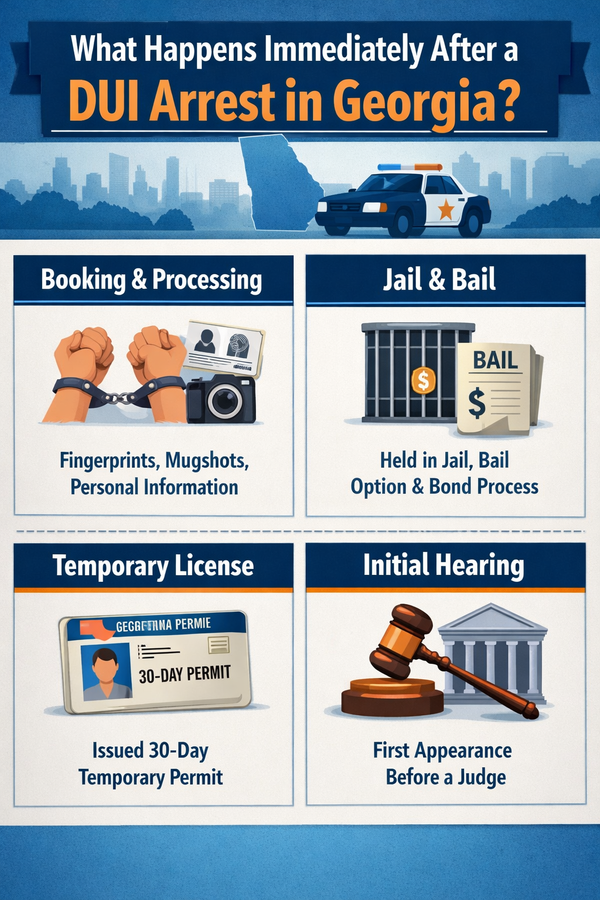
One of the most time-sensitive aspects of a Georgia DUI arrest is the threat to your driving privileges. When you are arrested for DUI, the officer will typically issue a DS-1205 form, which serves as your temporary driving permit and notice of license suspension.
You have exactly 30 calendar days from the date of arrest to either request an ALS hearing before the Office of State Administrative Hearings (OSAH) or apply for an Ignition Interlock Limited Driving Permit (IDP). Missing this window results in an automatic administrative suspension, independent of the outcome of your criminal case — meaning your license can be suspended even if your DUI charge is later dismissed.
DUI Less Safe vs. DUI Per Se
Georgia prosecutes DUI under two distinct theories. A DUI Per Se charge is based purely on your BAC being at or above the legal limit — it does not require the State to prove you were actually impaired. A DUI Less Safe charge, on the other hand, applies when the State alleges that you were a less safe driver due to alcohol or drug consumption, regardless of your measured BAC. You can be convicted of DUI Less Safe even with a BAC below 0.08% if the evidence shows your driving was impaired.
This distinction matters because it affects both how the State builds its case and what defenses may be available to you.
Building a DUI Defense in Georgia
A DUI arrest does not mean a guaranteed conviction. Georgia law provides numerous avenues for challenging the State's evidence, and an experienced DUI defense attorney will scrutinize every aspect of the case.
Legality of the Traffic Stop: The Fourth Amendment protects you from unreasonable searches and seizures. If the officer lacked reasonable articulable suspicion to stop your vehicle, evidence obtained as a result of that stop — including field sobriety tests and breathalyzer results — may be suppressed.
Field Sobriety Test Administration: The National Highway Traffic Safety Administration (NHTSA) has established standardized procedures for administering field sobriety tests. Officers who deviate from those procedures may undermine the reliability of the results.
Breathalyzer Accuracy: Intoxilyzer machines require regular calibration and maintenance. Records of improper maintenance, operator error, or failure to follow Georgia's required observation period prior to testing can all be used to challenge breath test results.
Blood Test Chain of Custody: Blood evidence must be collected, stored, and tested under strict procedures. Breaks in the chain of custody or laboratory errors can render blood test results inadmissible.
Rising BAC Defense: Alcohol is absorbed over time. If you consumed alcohol shortly before driving, your BAC may have been below the legal limit while you were operating the vehicle and only reached the prohibited level by the time you were tested. This "rising BAC" defense can be powerful when the timeline supports it.
The Bottom Line
The penalties for DUI in Georgia are severe, multi-faceted, and long-lasting. Jail time, fines, license suspension, probation, mandatory programs, and collateral consequences can affect your career, your family, and your freedom for years to come. And because the deadlines to protect your rights — particularly your driving privileges — begin running immediately after your arrest, time is of the essence.
If you or someone you care about has been arrested for DUI in Georgia, do not navigate this process alone. A knowledgeable Georgia DUI defense attorney can analyze the facts of your case, challenge the State's evidence, and fight for the best possible outcome — whether that means a dismissal, reduction, or a favorable verdict at trial.
Facing a DUI Charge in Georgia?
Don't wait. Contact our office today for a confidential consultation. We'll review your case, explain your options, and fight for your rights every step of the way.
📞 Call Now for a Free Consultation